Space, rocket and satellite operators run some of the most complex programs on (and off) Earth — and the back office has to keep up. In space, rocket and satellite operations, Asset Management — Equipment location tracking, geofence recovery, sensor monitoring and calibration. — is where missions are won or lost, and sensor monitoring & health is the part that decides the rest. ERP 2050 turns that complexity into an advantage, giving operators a real-time core that never sleeps and a single source of truth across the program.
What Sensor Monitoring & Health means for space operators
Equipment location tracking, geofence recovery, sensor monitoring and calibration. Every disconnected tool is another reconciliation, another place for errors to hide, and another reason finance, engineering and operations argue about whose number is right. Scaling the program means scaling that overhead — unless the operating model changes. Worse, none of it scales: every new program, site or partner adds another integration to maintain and another version of the truth to argue about.
How ERP 2050 runs Asset Management
ERP 2050 brings asset management onto one real-time, AI-native platform. In the context of sensor monitoring & health, that means:
- Capture every asset management event once and reuse it across the whole platform
- AI surfaces exceptions in asset management in real time, not weeks later in a report
- Policy-as-code enforces compliance and authorization inside asset management
- A complete, immutable audit trail across asset management
- Real-time visibility for operations, finance and the field at once
- Automation of the routine work, with humans in the loop where it matters
Operationally, it gives every team the same live picture — engineering, operations, supply, finance and the field all work from one model, so a change in one place is reflected everywhere instantly.
Why ERP 2050 is the better choice
Here is why operators choose ERP 2050 over a legacy core or a stack of disconnected tools:
- Legacy tools merely record asset management; ERP 2050 runs it and learns from it in real time
- One governed platform instead of spreadsheets and disconnected point tools
- Sovereign, export-controlled and audit-ready by design
That structural advantage is why operators who adopt ERP 2050 stop firefighting their own systems and start compounding gains mission after mission.
From mission demand to financial close
Because ERP 2050 connects demand, execution, evidence and finance on one fabric, the whole loop closes automatically: what your teams do in the field is reflected in the books in real time, what finance commits is grounded in live operational reality, and leaders finally get one trusted view of the mission, the program and the money at the same moment.
Sovereign by design
Sovereignty is built in, not bolted on: data residency by region, ITAR/EAR export control, operator certification and full audit trails come as configuration, so you scale across borders without losing control of sensitive mission data.
The outcomes that matter
For space, rocket and satellite operators, asset management on ERP 2050 delivers:
- Asset Management runs faster, cleaner and with fewer surprises
- Cost and risk in asset management fall while control and confidence rise
- Every decision in asset management is traceable, explainable and improvable
Talk to our team
Want a closer look? Contact our team at sales@blrcloud.com for a tailored walkthrough against your missions, lanes and constraints. ERP 2050 is the most modern ERP — real-time, AI-native, open and sovereign by design — and our specialists will show you exactly how asset management works for your missions.
Across the space economy, the operators pulling ahead run asset management in real time on one platform, not in scattered tools.
Every mission is a chance to prove the model: capture the data once, act instantly, and let the platform learn for next time.
How Space Process AI applies ERP 2050 to Asset Management
Space Process AI turns asset management into a governed operating system for launch providers, satellite operators, ground-station teams, space manufacturing companies and mission partners. The ERP 2050 core joins process data science, workflow orchestration, enterprise master data, financial controls, document evidence and AI recommendations into one execution layer. Instead of treating equipment location tracking, geofence recovery, sensor monitoring and calibration. as disconnected tasks, the application builds a live process model where every request, exception, forecast, approval, telemetry signal and report can be traced back to the business outcome it affects.
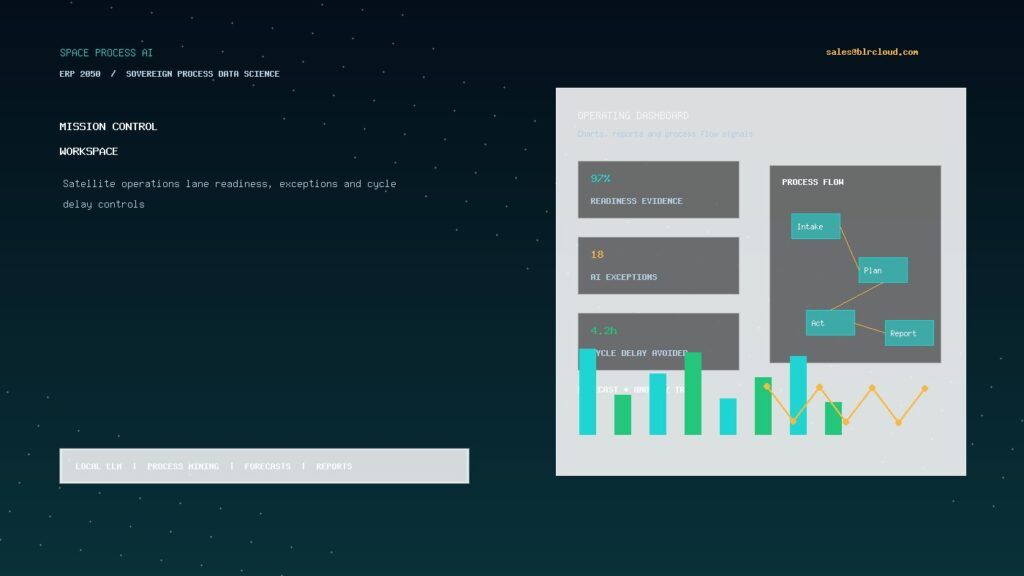
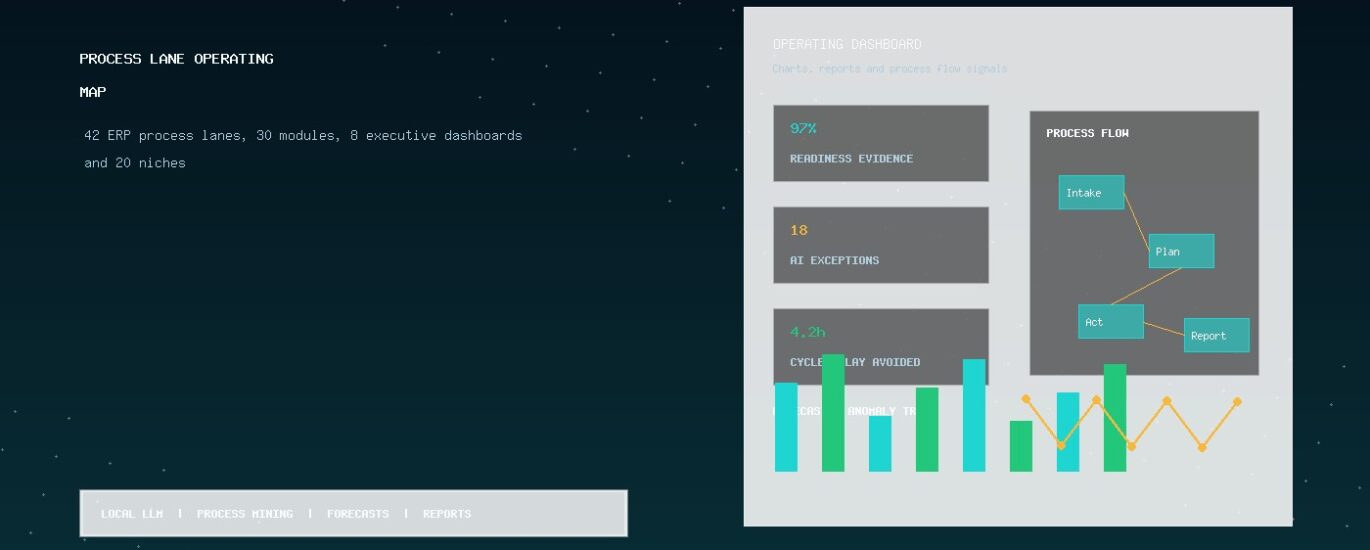
The app gives operating teams a dedicated workspace for intake, prioritisation, process mining, lane-level analytics, constraints, anomaly detection and forecast review. Leaders can compare planned versus actual execution, identify where a mission or customer commitment is losing time, and see whether the constraint is capacity, material, compliance, contract margin, engineering readiness, supplier performance, launch window availability or field support. ERP 2050 then turns that insight into action by routing exceptions, generating evidence packs, recommending next-best decisions and maintaining the audit trail required for sovereign and regulated space operations.
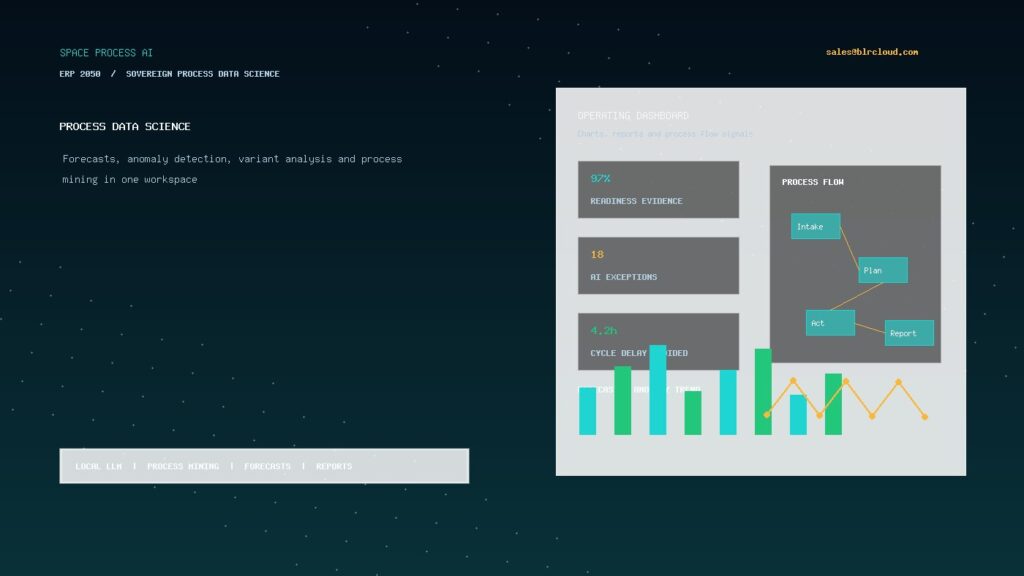
- Process data science: every transaction, task, forecast and exception becomes analyzable process data, so teams can discover bottlenecks and improve the operating model continuously.
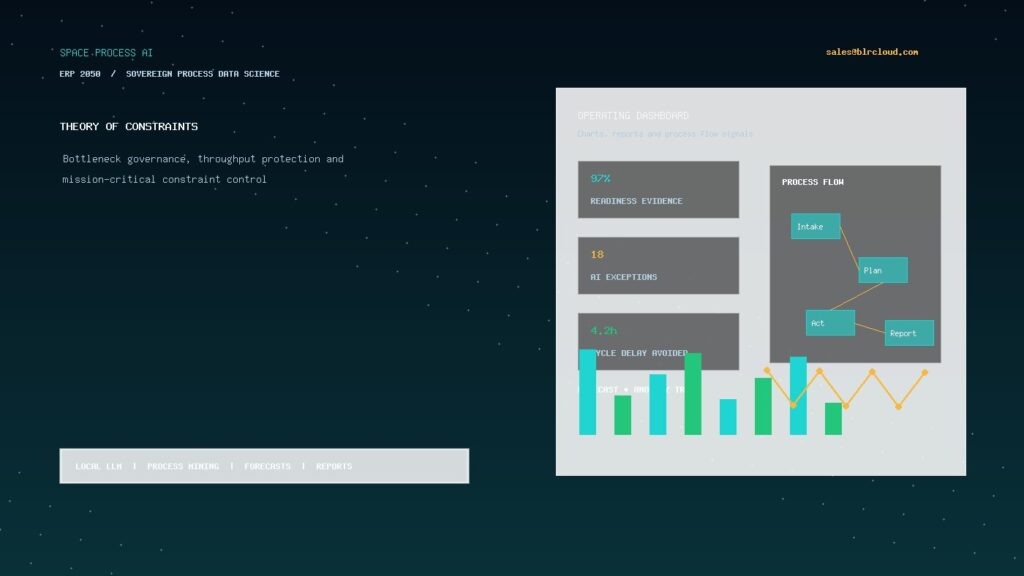
- Theory of Constraints: the dashboard highlights the limiting resource or workflow step, quantifies the business impact and helps managers protect mission-critical throughput.
- Forecasting and scenario control: ERP 2050 combines demand, schedule, inventory, payload, engineering and finance signals to model delays, capacity risks and revenue exposure before they become emergencies.
- Anomaly detection: local AI and governed GenAI assistants detect unusual cycle times, missing evidence, quality escapes, margin drift, supplier delays and field-service risk while humans remain in control.
- Reports and executive cockpit: every lane has chart views, process-flow views, table views and operating reports that make performance visible from mission floor to boardroom.
- Sovereign deployment: Space Process AI can be deployed with local LLM patterns, data residency controls and role-based governance for organizations that cannot expose sensitive mission data to uncontrolled systems.
For demos, investment conversations, enterprise pilots or a private walkthrough of this capability, contact sales@blrcloud.com. Space Process AI is designed to help space companies run faster, see constraints earlier, protect margins, reduce manual reconciliation and build a stronger operating system for the next generation of the space industry.
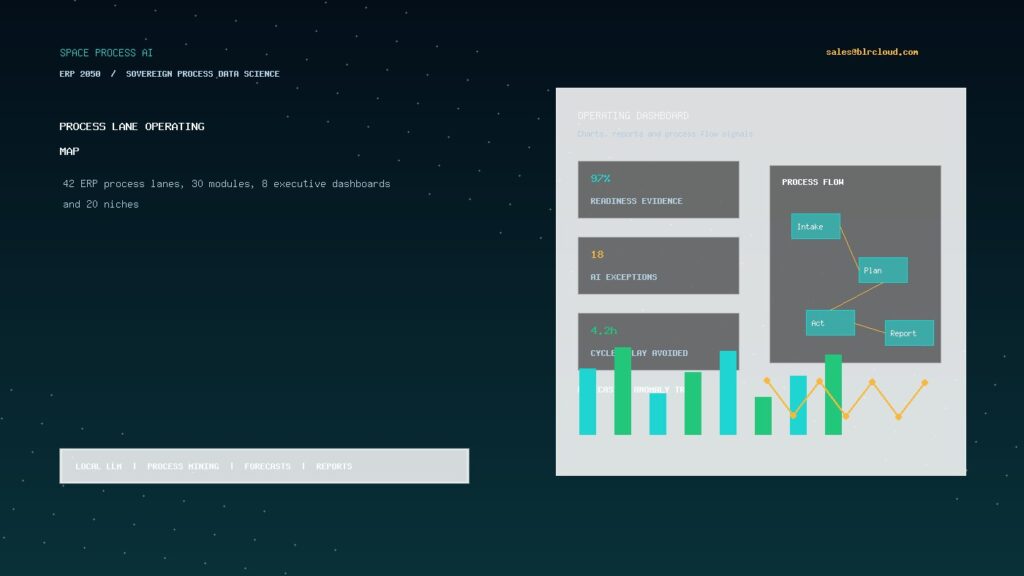
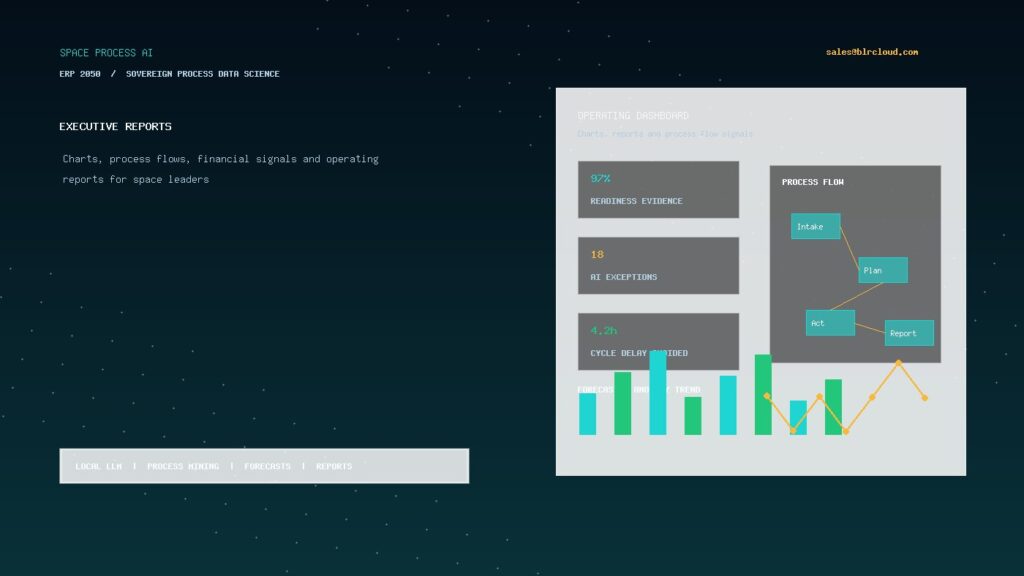
Space Process AI screenshots
These generated Space Process AI dashboard visuals show ERP 2050 charts, process flows, reports, process data science and Theory of Constraints views for space operators.